















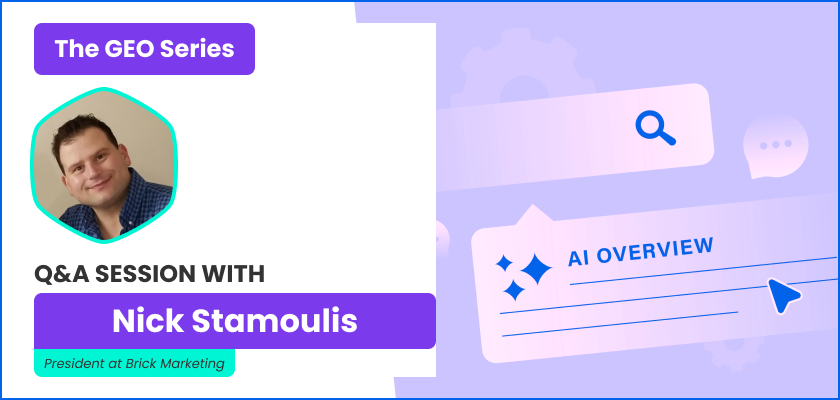
Brick Marketing on GEO: Making AI Visibility Work Without Perfect Data
As generative AI continues to reshape how visibility is defined, many agencies are navigating a key tension: how to deliver meaningful GEO outcomes in an environment where tools, metrics, and expectations are still evolving.
In this edition of The GEO Series, Nick Stamoulis, President of Brick Marketing, shares a perspective grounded in execution, focusing less on theory and more on what actually works in practice.
Based in Boston, Brick Marketing treats GEO as a core growth driver, with increasing client demand reflecting how quickly AI-driven search has entered mainstream marketing conversations.
GEO Strategy & Services
At Brick Marketing, GEO is not positioned as a separate service, but fully integrated into existing SEO and content workflows.
This reflects a practical approach.
Rather than redefining their offering, the agency extends what already works, aligning GEO with SEO, content marketing, and authority-building efforts.
At the same time, client demand is already strong.
Unlike some agencies still in earlier stages of adoption, Brick Marketing is seeing GEO inquiries very frequently, suggesting that awareness is quickly catching up with industry momentum.
What Brick Marketing’s GEO Services Include
Brick Marketing’s GEO work is built around visibility, authority, and continuous optimization within AI-generated environments.
Their process typically includes:
- Auditing brand visibility across AI search platforms
- Identifying gaps in how the brand is surfaced and referenced
- Developing a GEO strategy aligned with SEO and content goals
- Executing technical updates and authority-driven content
- Building citation signals and monitoring performance over time
What stands out here is the emphasis on continuity.
Rather than introducing entirely new workflows, GEO is embedded into existing processes, making it easier to operationalize and scale.
How Brick Marketing Structures GEO Services
Brick Marketing follows a cross-functional model, where GEO ownership is shared across teams rather than assigned to a single role.
Their framework focuses on:
- Integrating GEO into SEO, content, and analytics workflows
- Aligning execution with both technical and content-driven outputs
- Maintaining consistency across owned channels
- Continuously monitoring and refining visibility signals
This structure creates a more connected system.
Because GEO is not isolated, it becomes part of a broader performance ecosystem, allowing insights to move across disciplines.
How GEO Actually Works
For Nick Stamoulis, the shift from SEO to GEO comes down to how content is evaluated.
Generative AI systems prioritize:
- Clarity
- Relevance
- Authority
While these signals are not entirely new, the way they are applied is different.
Instead of ranking pages, AI systems assess whether content is clear enough to be understood, relevant enough to be included, and authoritative enough to be trusted.
This shifts the goal of optimization.
Visibility is no longer just about competing for position, but about ensuring that content can be interpreted and selected within AI-generated responses.
For Brick Marketing, this reinforces the importance of:
- Strong brand and entity signals
- Consistency across owned channels

Measuring GEO Performance
Measurement is where Brick Marketing’s approach becomes particularly pragmatic.
Rather than relying solely on emerging GEO-specific tools, the team looks at a combination of signals, including:
- Brand authority and positioning within AI responses
- AI-assisted branded and organic search lift
- Direct traffic and visits from LLM environments
This reflects a reality many agencies are facing.
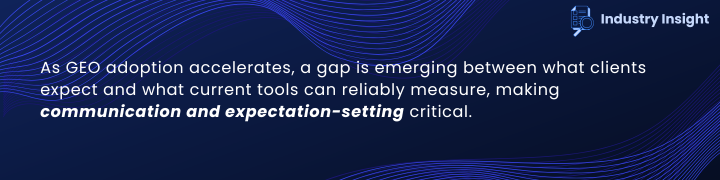
The tools available today are still limited, making it difficult to rely on a single, standardized measurement framework.
As Nick notes, performance is often inferred through directional indicators, rather than precise attribution.
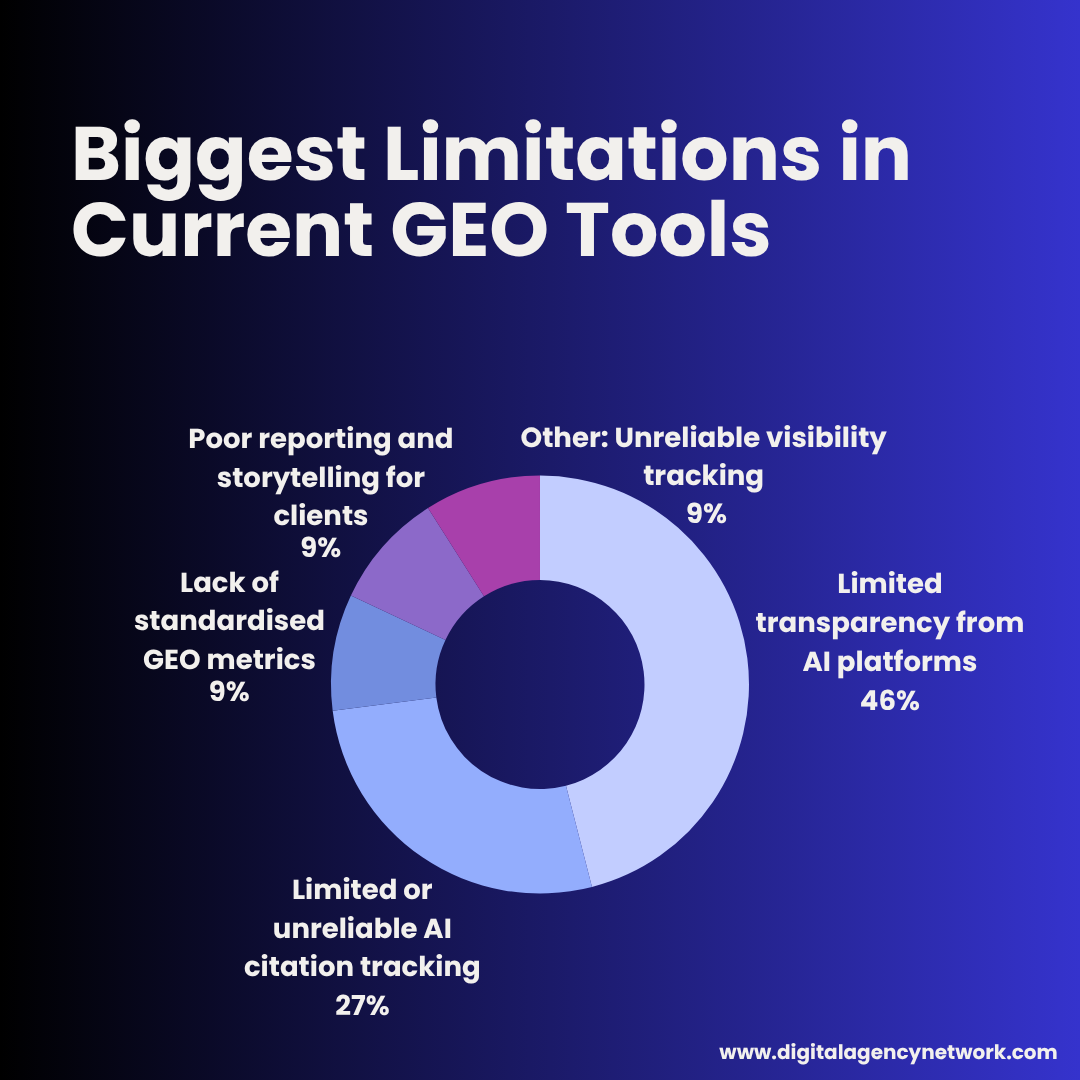
Across the dataset, this challenge reflects a broader pattern. Most agencies highlight limited transparency and unreliable citation tracking as the biggest barriers to measuring GEO performance effectively.
Tools, Platforms & The Future of GEO
For Nick Stamoulis and his team, GEO is shaped by a broad set of platforms where AI-driven discovery is happening.
Today, ChatGPT, Perplexity, Google AI Overviews, Gemini, and Claude are all considered critically important, highlighting how fragmented the landscape already is.
To support this, Brick Marketing relies on a mix of:
- Google Search Console and Google Analytics for baseline performance signals
- SEMrush for visibility and keyword insights
- SEMrush AI Visibility Toolkit and Otterly AI as GEO-specific tools
However, like many agencies, they point to a fundamental limitation: “limited transparency from AI platforms”.
Without clear insight into how AI systems evaluate and select content, optimization remains partially opaque.
The Future of GEO
Looking ahead, Nick Stamoulis sees GEO becoming:
“The invisible layer powering all search decisions.”
This perspective suggests a future where GEO is no longer a distinct discipline, but an embedded layer across all digital visibility.
As AI becomes the primary interface for information discovery, success will depend less on individual tactics and more on how consistently a brand is understood, trusted, and surfaced across systems.